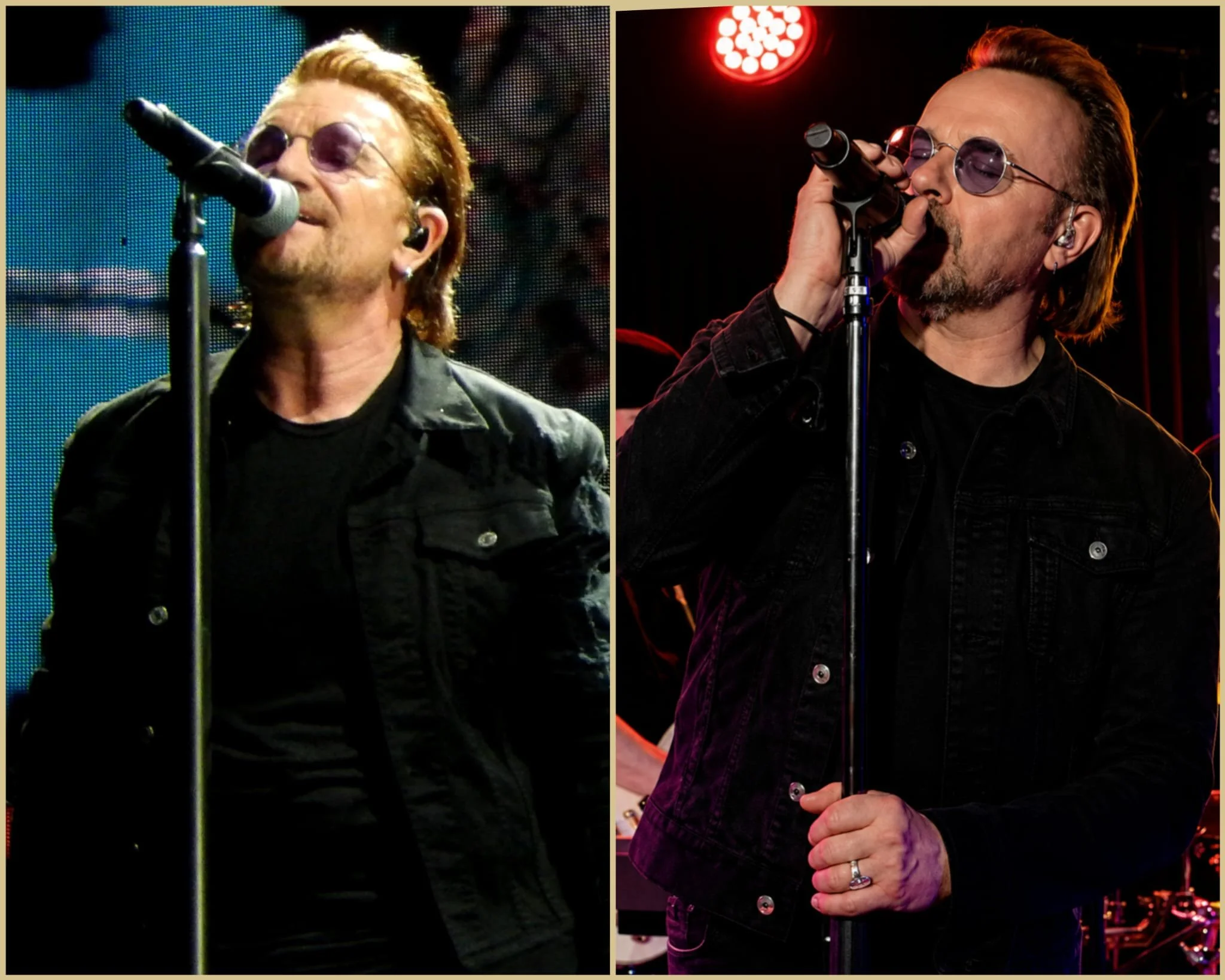
U2Baby's Bono on Becoming the Frontman
Some fans call him Budget Bono. It's an affectionate nickname, and Ric — who fronts U2Baby, one of the world's leading U2 tribute acts — takes it in good humour. But spend five minutes talking to him about what actually goes into the role, and "budget" is the last word that fits. The gear is real. The jackets are real Dior. The commitment is total. What's on a budget, if anything, is the ego.
Fronting a U2 tribute isn't about impersonation. It's about chasing a feeling — the one Bono has spent five decades building in stadiums and small rooms alike. We sat down with Ric to talk about how he approaches that, night after night.
The Moment It Clicked
Ric traces it back to one performance: Live Aid, 1985.
"I saw Bono captivate an audience not with manic movements but with pure emotional connection," he says. "A different feeling to what I was used to seeing from live bands." It was the moment Bono broke the fourth wall and walked out into the crowd that sealed it. "I was hooked."
But it wasn't the early, incendiary Bono that Ric ultimately chose to chase. It was the Innocence + Experience tour, decades later, that got him — literally — up against the barrier. "I felt a presence bigger than his stature," he says. "You could feel every emotion." He returns often to a phrase he's used to describe the whole project: "We didn't write the songs, we didn't live the life — we just honour those stories." Hearing Bono sing "Iris," written for his late mother, on that tour is the moment he keeps coming back to. "That just hit hard."
The Art of Presence
Ask Ric about the "big personality" reputation that follows Bono around, and he doesn't dodge it — he leans into it.
"People forget he's in show business — two words there. Show and business," he says. "If you're not going to go for a big personality, you're in the wrong job." What frustrates him more is the reflexive cynicism that's grown up around Bono in recent years, disconnected, in his view, from the facts. "If people fact-checked stuff, they'd see a lot of it is just manufactured noise."
Vocally, Ric doesn't chase an exact impression. "I don't sound identical to Bono, tone-wise," he admits. "But I capture his emotion and storytelling — I've been told many times my voice 'cracks' like his, with that same emotional connection." He's deliberate about it: "True mimicry can come across even more fake sometimes. Sung from the heart, phrased correctly, in lock step with the musicians — that carries far more weight."
Physically, though, he goes to remarkable lengths. Real Dior jackets. Jewellery made as exact replicas. The famous mic stand, never missing. And, most memorably, a private reference document he built for himself — nicknamed the "Kung Fu book of Bono moves" — cataloguing gestures like Squeezing the Avocado, Gorilla Down, and Attacking Invisible Air. "The sound is important, the look is important," he says, "but ultimately it's the feel we're aiming to recreate. The chills. The hairs on the back of the neck. Tears, even."
The Hardest Parts to Replicate
Ask him which song gives him the most trouble, and Ric reframes the question entirely. "I don't think there is one," he says. "The only reason we exist is to bring joy to people." He points out that U2 themselves effectively sanctioned the concept, with the Doppelgangers appearing in the "Even Better Than the Real Thing" video. What's harder, he says, is dealing with online criticism from people who've never actually seen the band live. "No one who has ever been has had a bad word to say," he says. "You have to be there before you can judge us." He borrows a line from Larry Mullen Jr. that's become something of a mantra for handling it: "I don't give a shit if you don't like U2. So you can type. Well done. Get over it."
Technically, Ric is candid about where the real difficulty lies. "Emotional conviction is easy — the songs hit so hard, it's often hard to hold back the tears," he says. "Vocal technique is the harder thing. His range is huge, both in the early days and today. He's a master, and that's no easy feat to replicate." One moment stands above the rest: the "wide awake" scream in "Bad." "You just have to believe you can hit it — and scream it."
Playing It Live
Ric describes himself, deliberately, as "a singer first and an actor second." He doesn't chase Bono's vocal tone directly — he chases the phrasing, the emotion, the notes. "The rest follows," he says. Off stage, that separation matters too. The band mingles with fans after shows, never before — "too invested in getting in character" beforehand, and using that time afterward to help him "come down" from the performance.
The role has changed him as a performer entirely. "I used to stand still on stage and sing behind the mic stand," he admits. "Now, armed with my Kung Fu book of Bono, I try to live his performances — jumps, close contact, static emotional pieces. It's all there, and I feel at home with it."
The Bigger Lesson
If there's one thing studying Bono has taught him, it's this: "Whatever you believe in your head at the time projects to the audience," he says. "Sometimes you can think too much, and the whole thing feels a bit jaded. It's the moments when you forget yourself that work the best."
As for what he'd ask Bono, given the chance, Ric doesn't hesitate: "What do you like best about U2Baby?" It's a question he'd happily set alongside one he already has — a review from Guggi, Bono's own longtime friend, who once wrote that he "thought U2Baby were amazing," adding, tongue firmly in cheek, that he "preferred them to U2" — if only because it was easier to get in. "We can take it good or bad," Ric laughs.